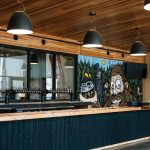
Instead of embracing the beauty of public and outdoor drinking, Americans have largely relegated alcohol consumption to bars, implicitly marking them as dark dens of adult iniquity. Fortunately, small breweries are pushing for change.
Great Notion’s second location offers plenty of growing room for the three-year-old company, along with to-go coffee six days a week, an expanded menu, and most importantly, more beer.
Reuben’s Brews, which already maintains three locations in Seattle, is growing again. In December it adds an even larger 30-barrel production facility with a bright new taproom.
Whether or not to welcome kids into taprooms has become a hot-button—and often unexpected—issue for brewery owners aiming to please a wide variety of beer drinkers.
John Bedard has become the go-to brewery architect in Brooklyn, with projects from Threes, Kings County Brewing Collective, Grimm, and more making up nearly half of his current portfolio.
The rapid transformation and mutation of American craft brewing will undoubtedly persevere in the year ahead. Yet one thing always remains the same: the absence of boredom.
When a Secret Hopper goes “undercover,” they are expected to order a flight, followed by a pint, and pay attention to 25 points that they will later critique in a report.
Taking cues from the pub and taproom model used by smaller breweries, big players in the beer industry, from 10 Barrel to Blue Moon and Lagunitas, attempt to cash in on the convenience and sense of community of urban outposts.
Beer drinkers at Worthy Brewing can gaze into the cosmos while sipping on an IPA at the Bend, Ore., brewery’s new “Hopservatory,” featuring a 16-inch RCOS-based Ritchey-Chrétien telescope.
Looking for a better solution for their old wooden beer paddles, Buffalo, N.Y.-based Resurgence Brewing owner Jeff Ware and crew set out to build a better taster tray.
In one of only two states that still doesn’t allow breweries to sell directly to consumers, Georgia brewers rally together against restrictive policies.
Since launching Victory in 1996, Bill Covaleski and Ron Barchet have remained true to their founding principles. When it came time to expand, they added a second production facility in Pennsylvania even as their distribution has grown.
In 2007, when BeerAdvocate became the country’s first monthly beer magazine, the combined output of 1,406 craft breweries represented less than four percent of the total market in the US.
Across the country, craft breweries have coffee specialists going far beyond mere coffee-beer collaborations. Taking notes from beer, coffee shops hope to increase conversation and connectivity between the parallel crafts, opening both to new customers and ideas.
A bill widely viewed as a setback for Florida craft brewers died in the state House. After passing the state Senate with a 30–10 vote, Florida Senate Bill 1714 would have prohibited brewers making more than 2,000 kegs per year from selling more than 20 percent of their beer on-site.
The ease of attaining and enjoying many of the world’s greatest beers today stands in stark contrast to a time when beer lovers had to travel far and wide to get a sip of a long-coveted beer.
Basecamp. Outpost. Those are the two halves of Devils Backbone Brewing Co., one of Virginia’s fastest-growing beermakers. And in their short life span, Devils Backbone’s two brewhouses have garnered 23 medals at the Great American Beer Festival and five more in the World Beer Cup competition.
Breweries are starting to realize that it’s time to rethink the standard tour they’ve been offering unchanged for years. As breweries remain in a near constant state of expansion, designers are starting to integrate expanded taprooms, beer gardens and community meeting spaces.
In marketing, connecting a face to the “brand” means something. But for the small guys who can’t afford national publicity and TV commercials, that connection and personal brand management becomes a physical reality with their taprooms.
Garage breweries aren’t brewpubs in any traditional sense. You won’t find any food, beyond peanuts or popcorn, and the beer is usually sold off-site as well. And you’re always aware that the brewery hovers around you, not hidden away behind glass partitions.