The name Watney conjures up very different emotions either side of the Atlantic. Many North Americans nurture fond memories of Red Barrel as a quality import. Older Brits mostly harbor a lingering contempt. But what’s the truth about Watney’s beer? Was it really that bad?
Carlsberg’s Carl Jacobsen had clearly been impressed by what he’d seen on his travels and brought back an enthusiasm for British ales. So much enthusiasm that he started brewing ales alongside the lagers you would expect.
It’s clearly not for the geeks among us—the homebrew chapter is entitled “Make your own beer in two hours”—but buried in this novelty book are some legit factoids.
Devon, Cornwall’s nearest English neighbor, has its legend of White Ale. Was there a similarly exotic indigenous beer style in Cornwall. Naturally, mentions of a mysterious brew known as “swanky” among lists of Cornish recipes online, generated considerable excitement.
Berliner Weisse entered the twentieth century in robust health. New-fangled lager beers had dented its popularity a little, but it remained one of the city’s favorite styles. That was to change as the century progressed, and its popularity slowly declined.
Like all styles that have been around for more than five minutes, Berliner Weisse has undergone several transformations, adapting to technological, political and social change. It’s currently in a very sad state in Germany, hanging on by a thread. Only one version, Kindl, is made in any quantity.
An archaeological excavation on a construction site in central Tel Aviv, Israel, has unearthed what may have been an ancient Egyptian brewery. The dig revealed fragments of large ceramic basins used by Egyptians to make beer approximately 5,000 years ago.
In the second half of the 19th century the types of beer brewed in Sweden changed radically. The original, purely indigenous styles were gradually swept away by imports from elsewhere, and Sweden was very early to jump on the lager train.
Belgium was wrecked after WWI. It was enough to drive citizens to drink, but in 1919 the Belgian government passed the Vandervelde Act banning the sale of distilled spirits.
Robert Wahl had a distinguished career as a brewing science educator. But one of his greatest legacies is a book that shines a light on American brewing in the immediate aftermath of Prohibition.
When statisticians crunch numbers, they traditionally want big piles of data to ensure accuracy. But what if the question is something simple, like: Did this new hop affect people’s perception of my beer? Most breweries can’t whip up thousands of opinions for a single batch of beer.
Every hue of IPA and dozens of Stout sub-types are recognized in style guidelines, but Czech beer is reduced to “Bohemian Pilsner,” a name that would leave a Czech drinker scratching his head. Meanwhile, the country is awash with an array of lager styles, more than anywhere else in the world.
Bruges’ De Halve Maan brewery will soon build an underground pipeline to move beer. Once operational, the pipeline will transport over 4 million liters (roughly 34,000 barrels) of beer per year to a nearby bottling plant.
I’m sure you’ve all heard of IPA, but what about KK, SS and AK? British brewers once loved to string together beer names from a few letters. But what on earth do they all mean?
We’ve all heard of Berliner Weisse, but who now remembers her brunette sibling, Berliner Braunbier? She’s disappeared without a trace, despite, unlike many German top-fermenting styles, being brewed within living memory.
Heineken is synonymous with the Pale Lager called Pilsener that still dominates the world. The vast majority of the beer they brew is in that style. But that wasn’t always the case.
When it closed in 1934, Hoare and Co. was one of the oldest businesses in London, dating back to Tudor times. Today, the site is home to a block of apartments, and not a trace of the brewery remains. Will the Hoare name ever return?
Watching his old brewhouse in Washington fall into disrepair made Bret Dodd wonder: What happens to the other failed breweries scattered around the country? So Dodd hit the road with his camera, investigating seven still-standing pre-Prohibition breweries.
In the middle of the 20th century Light Ale, buoyed by the surge in sales of bottled beer, was a rising star of Britain’s pub trade. The dubious quality of much draft beer prompted drinkers to start mixing it with bottled beer. Light and Bitter—a half-pint of Ordinary Bitter topped up with a bottle of Light Ale—was one of London’s favorite tipples.
Until recently, locals knew South Bermondsey Station as the closest stop to The New Den, home of Millwall, the city’s most blue-collar soccer club, but times have changed. Saturday morning now sees a steady stream of punters disembark here, most of them looking for beer.
Whitbread created one of the most useful documents for anyone interested in the history of British beer: their Gravity Book. In it, they documented thousands of samples of competitors’ beers, from the early 1920s to the late 1960s.
According to many beer histories, English Stouts—Milk ones excepted—disappeared in World War I, allowing Guinness to dominate. It’s another example of projecting the present backwards. As usual, the truth is much more complicated.
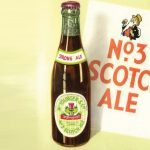
Like all beers that have been brewed for a long period, No. 3 has undergone many changes. No. 3 is also a beer that’s refused to die, no matter what history has thrown at it. If you’re ever in Scotland, you should give it a try.